Making geographical thinking habits the thread that runs throughout our curriculum.
A take on the KS3 Geography Curriculum (opinion).
I wonder if we asked students by the end of Year 9 the following questions:
‘What is Geography?’ or ‘What does geographical thinking look like?’
What would they say? What does their answer tell us about our curriculum?
How many of them would say something vague like ‘ummm… the world?’.
The recent drive for curricula to have clear intent at KS3 has led to a lot of thinking along the lines of ‘what do want students to know by the end of Year 9 geography?’. That is obviously important, as students need a core body of knowledge to be able to think with. “We think with what we know”. But I also think that the conversation would benefit from including “How should students be thinking by the end of Year 9 geography?”.
Since thinking is largely habitual, I’d add another layer to that question, so it becomes ‘What thinking habits do we want our Year 9 geographers to have embedded?’.
Through this approach, the intent of a KS3 geography curriculum becomes clear:
By the end of Year 9, students should leave with not just a deeper understanding of the world, but distinct habits of geographical thinking.
So that statement of curriculum intent above has two main parts to it: The ‘deeper understanding of the world’ and the ‘distinct habits of geographical thinking’.
The former, I would argue, is simpler to satisfy. Most KS3 geography curricula will have a broad range of physical and human topics that lead to students knowing more about the world around them. If taught, revisited, and assessed well, students understanding of the world should deepen.
The latter though, I think is harder to achieve. ‘distinct habits of geographical thinking’ – how do we equip students with these?
Firstly, what are these habits? I don’t think this is an exhaustive list, but here are 6 habits that I believe to be core to geographical thinking.
Thinking about issues in the short + long term, and assessing their sustainability
Thinking about issues from multiple perspectives
Thinking about issues using real-world case studies, geographical information (GIS) and evidence
Thinking curiously about spatial distributions, the form of landscapes and local/global patterns
Thinking about the interconnectedness of the physical and human world
Thinking about how primary inquiry and fieldwork could enhance our understanding of the world
So, we want our students, at least by the end of year 9 (and hopefully beyond!), to be able to articulate what geographical thinking looks like. We want them to have at least those 6 habits of geographical thinking embedded. Having students being able to articulate this list off the cuff may be ambitious, but at the very least we want these core elements of geographical thinking to become habitual for them. This post argues that, by putting thinking habits at the core of our curriculum design and lesson planning, we could end up with a more intentional KS3 learning journey that leaves students with a more concrete understanding of what geographical thinking looks like.
So how could we act on this and build a curriculum that leaves students with these habits of geographical thinking?
The first step would be to look at a unit we teach, and ask ‘What are the thinking habits that we want that this knowledge to support?’. Every unit (or indeed every lesson) that we decide to include in our KS3 geography journey must be there for a reason, and that reason should be to deliberately create opportunities to practise these geographical thinking habits. In a curriculum review, we might ask ourselves: ‘Which of these geographical thinking habits does this lesson or unit visit?’ or ‘Is there any of these thinking habits that we have missed in this unit that we need to include or indeed emphasise more?’. We don’t want all 6 in every lesson (or any of them to be shoehorned into every unit), and certainly not through a token question at the end of a PowerPoint. Rather, the units should be designed to facilitate the development of these thinking habits throughout, and each unit after that has opportunities to revisit and develop that thinking over time. I suspect most geography teachers will already recognise these thinking habits as things they already do and often bring up in lessons. I think the value lies in making the intention of embedding these thinking habits more explicit in our teaching, our lesson design, and our curriculum design. The habits of geographical thinking should be demanded in the assessment of the unit, in the lesson discussions, in our explanations, or in the ‘learning objectives’ if you use these.
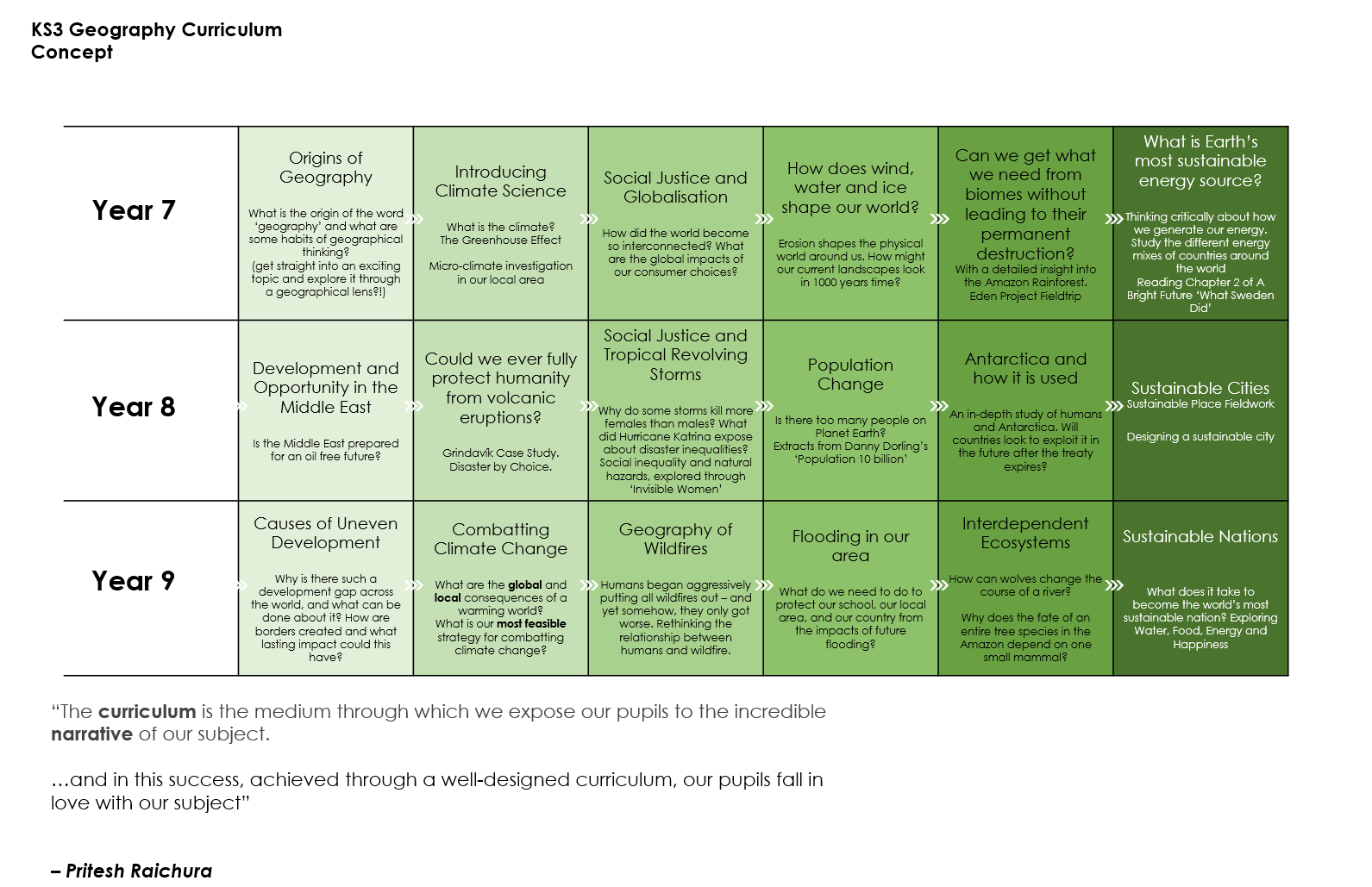
Take this rough idea of what a KS3 geography curriculum could look like… (not a real or implemented one – just a very rough concept that I’ve drawn up). Does this curriculum have the potential to satisfy the statement of intent from earlier: ‘By the end of Year 9, students should leave with not just a deeper understanding of the world, but distinct habits of geographical thinking’ ?. For the first part, I’d argue that this curricum does contain a broad range of geographical knowledge, and if this knowledge was taught well, revisited well, and assesed well, then it should absolutley leave students with a deeper understanding of the world. But would it leave them with a concrete idea of what geographical thinking looks like? Would this curriculm make geogaohical thinking habitual in our students’ minds by the end of year 9?
I’d say it depends… If we just planned these units and put in different bits of content without intentionally weaving those thinking habits throughout, we run the risk of students ending up with a slightly unclear definition of what geography or geographical thinking actually is. They might appreciate that in geography lessons, we learn exciting ideas and stories about the world, but we want to couple this with the development of geographical thinking over time. So, this curriculum concept would be strengthened by making those 6 thinking habits the thread that runs between the units.
Take these two units at the start of Year 8. Unit 1 – covering the Middle East and Resource Future, and Unit 2 – covering some Tectonic Theory and Volcanic Mitigation in Iceland. When we teach them, would we teach them in isolation of each other? To some extent, yes. They are obviously so different in terms of what knowledge we are teaching. But actually, both units should draw upon the same geographical thinking habits, and we should make that clear. In the Middle East, we should be thinking about the long-term, about what fieldwork data we could use to enhance our understanding, about patterns and distributions, about multiple-perspectives, and certainly about real-world evidence and case study. I’d argue that the Volcanic Mitigation in Iceland topic should also designed around facilitating these same thinking habits. We should also narrate this clearly, so that students begin to see that although geography covers a super wide range of topics, there are some distinct thinking habits that act as thread between them – giving geography a stronger identity as a subject. If we begin making these habits explicit when teach and across different units, will our students begin to recognise the unique aspects that make up geographical thinking more clearly? Perhaps this will lead to our students having a clearer and more concrete understanding of what geography actually is?
A lot of existing literature frames suggests that the geography curriculum should be designed around revisiting big ‘threshold concepts’ or ‘key questions’, with units that continuously spiral back to them. Could reframing this idea around revisiting the key habits of geographical thinking instead be a subtle adjustment that leads to students being more articulate at defining what ‘thinking like a geographer’ looks like, and give geography a stronger and more tangible identity? Could this mean that, when we get to the end of Year 9 and we ask our students ‘what is geography?’, instead of resorting to the age old cliches of rocks/colouring maps, or a generic statement about the world, they instead answer by bringing up some (all!?) of these thinking habits?
Last thought:
“Education is what remains after you have forgotten everything you learnt in school.”
I first encountered this quotation at the sixth form college of one of the first schools I worked in. I’m not even entirely sure the extent to which I agree with it. But as a bright-eyed early career teacher, I must admit that I found it a bit deflating. So much of my job involved teaching geographical knowledge, facts and details, much of which, apparently, would eventually be forgotten. But if we accept that students will inevitably forget some of the specific facts, explanations and case study details we teach them, what is it that we hope remains? Perhaps, long after they have forgotten the different types of erosion or the finer details of a case study, they will have retained something more fundamental: a way of thinking about the world around them that has been shaped by their geographical education. A habit of approaching issues geographically, asking different questions and making sense of the world through the lens of geography.
I'm not pretending by any means to have a definitive answer to what KS3 Geography should look like (does anyone!?). But I am starting to think that framing our KS3 geography curriculum around the idea of building lasting thinking habits could leave our students as better geographical thinkers, and give geography a stronger identity.
So could we ensure that our KS3 geography curriculum leaves students with the lasting habits of thinking geographically?
I’d argue yes! But it requires us to carefully plan and construct our units of work to not simply refer to these habits occasionally, but make them the very thread that runs through our KS3 geography curriculum.
I'd love to hear how other geography departments approach KS3 curriculum design.
Do reach out!