Most students are more likely to remember something that they have talked about.
One of the biggest challenges of teaching is that a lesson can appear successful in the moment, without necessarily leading to learning that sticks. Students may follow an explanation, answer questions correctly and complete a task, yet struggle to recall the same knowledge weeks later.
I had this my first time round teaching the formation of waterfalls to a year 10 class in my first year of teaching. I was happy with the lesson when it happened. The explanation was chunked, with clear diagrams to aid, and by the end, students in the lesson were writing down brilliant step-by-step sequences that were accurately explaining how waterfalls and gorges form. We did a mini-whiteboard quiz, ‘complete the explanation’ on your boards, and key terms such as ‘differential erosion’, ‘rock resistance’, ‘hydraulic action’, ‘plunge pool’ and ‘retreat’ were being identified and written by everyone in the room. I thought I’d nailed it… But a few weeks later, an end of unit test begs to differ.
Why had the knowledge not stuck? That question is difficult to answer, and frankly could be down to a wide range of factors. The ‘forgetting curve’ and not revisiting the knowledge enough, perhaps? “If you don’t use it, you lose it”. I think this definitely played a part (it always will). Of course there is every chance that I just hadn’t explained it very well… But for the purpose of this post lets just conveniently assume that I had done at least an okay job of explaining it, and think about what else could have been relevant. On reflection, I realised there was likely something a lot simpler at play – something that I could trace right back to the planning of the lesson. I realised that during my lesson, I had overlooked numerous opportunities for students to talk.
This realisation came to me in a CPD session by Tom Sherrington - a video titled ‘Kitchen Pedagogy: Pair Talk for Checking for Understanding and Fluency’. A direct quote from the video: “If there is any vocabulary or terminology that you want students to have, if they are not using it or saying it, it us unlikely that it is going to be embedded”. The ideas he shares here and on other platforms have shaped how I now approach teaching these concepts.
So, perhaps one of the problems with my lesson was that I didn’t engineer an opportunity for everybody to say the words I wanted them to remember out loud. Sure, everyone was using them on whiteboards, and a cold-call style questioning gave some students the opportunity to say the words out loud with prompting, but not everybody. I believe this was one of the flaws in the lesson.
So, back to the lesson planning. How could I engineer an opportunity for everybody to rehearse the words and explanation out loud? Is 34 teenagers individually talking through the formation of a waterfall in the same lesson possible!? In the first instance, I could adopt a simple ‘I say, you say’ routine. Choral response with new key terms. That’ll get students saying the individual words for sure, but how about actually using them independently in an extended explanation?
Here’s a routine that I learnt that does just that: Rehearsing in Pairs.
“oh no, sir has printed out those player A and B cards again…” - sighed the anonymous Y11 student last year.
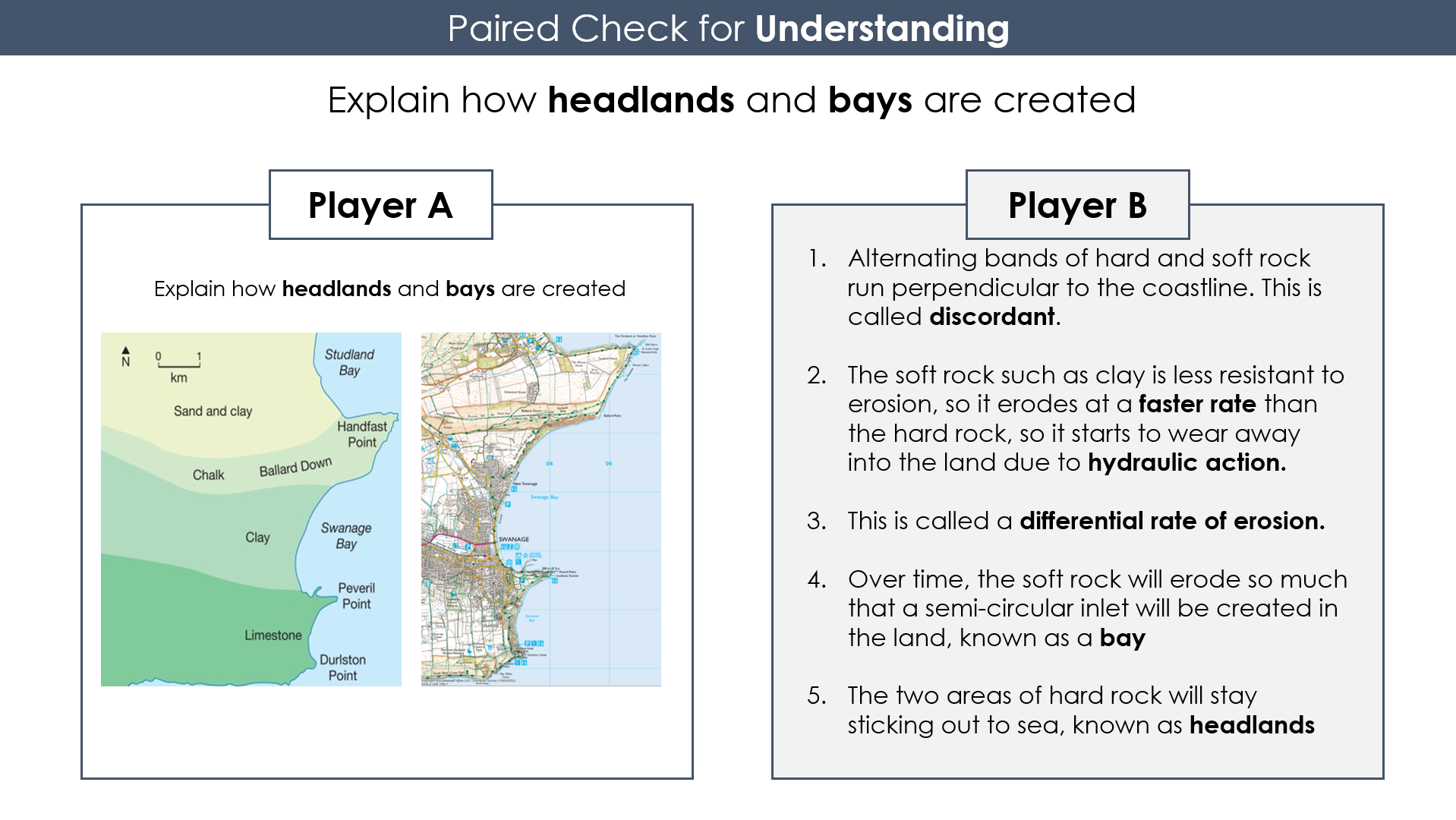
The routine is simple. In your pairs, label yourself Player A and Player B, and pick up your cards.
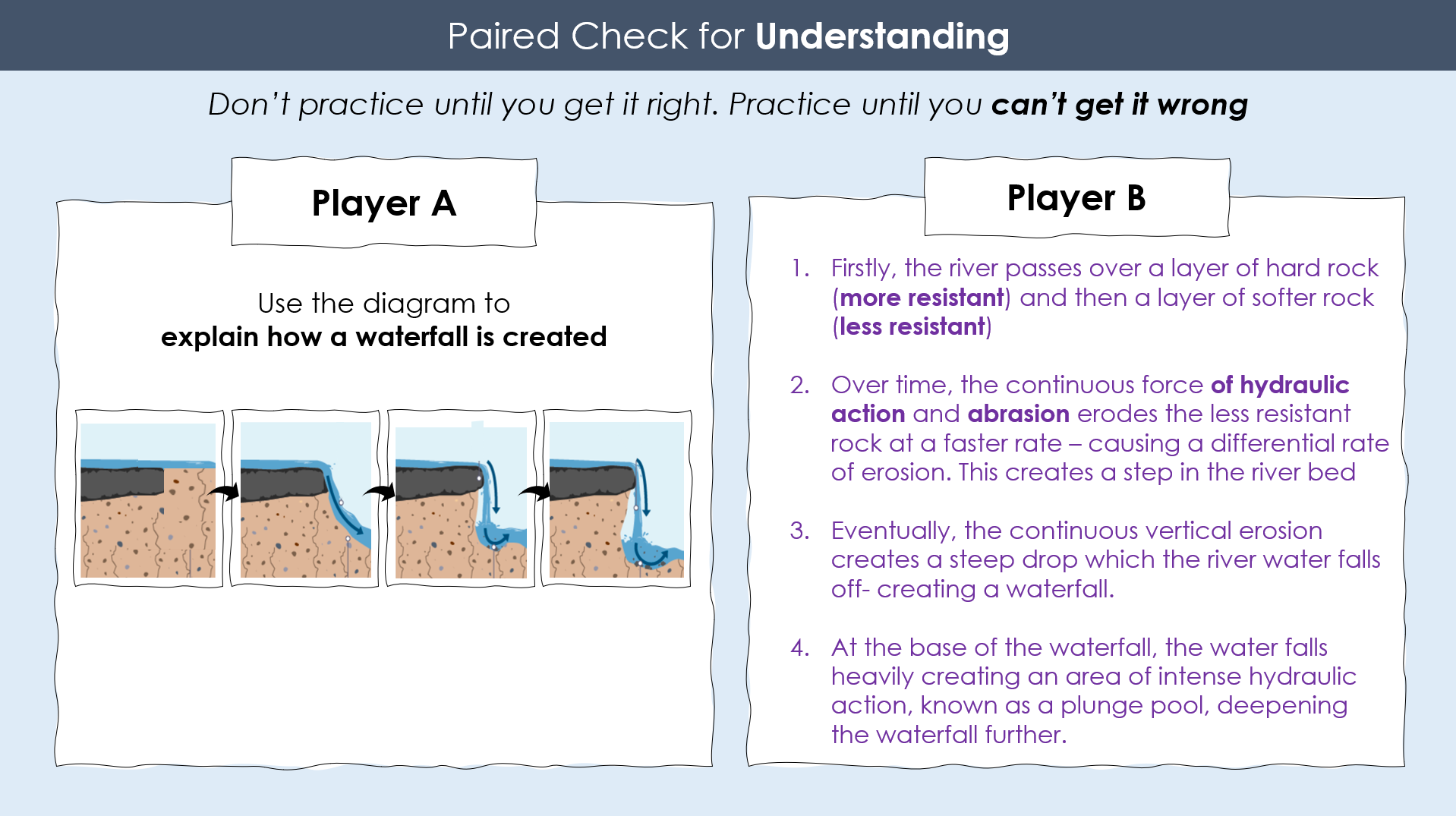
Player A – your job is to use your diagram to explain to Player B how a waterfall is formed. Try and use all of the new key terms from today, and go step-by-step. Give it your best shot.
Player B – you have the perfect model answer on your card, and your job is to listen to Player A, and check that they are getting it right, and using all of the correct key terms. Help them out if they need it at first! Importantly - don’t let them off the hook with any key terms!
It helps to model this processes with a student first for the class to see how the routine works, and to model what good help/prompting can look like without just giving your partner the answer.
It also helps to frontload the behaviour expectations:
“Now, crucially, as I am walking round, I want to hear nothing but rehearsal, so make sure you keep repeating it until I stay stop. Don’t practice until you get it right, practice until you can’t get it wrong”.
3 minutes later…
At this point, half the room have practiced and rehearsed.
Swap your cards.
Repeat.
An easier job perhaps for the new Player A, as they have just been staring at the model answer for 3 minutes and hearing it out loud from their partner. This is true. Perhaps this is how we can differentiate – by giving our less confident students the Player B card first. This way, they are more likely to participate and feel confident practicing verbally on their turn.
So after a 6 minute activity, everybody in my classroom has had the chance to explain how a waterfall has formed out loud. They have used the words, repeated them out loud, and had their answers checked against a model answer. Now at this point, I often move to a silent independent writing task: “put your cards away, turn to some blank paper, and explain how a waterfall is formed”.
Usually, these moments in my lessons (the moments where I ask students to write an explanation that they have been verbally rehearsing for the last 6 minutes) are some of the most silent and focused periods of time that I manage to create. After 3 minutes, students can simply get the Player B card back out, and see how they did… add in any corrections.
I like this routine a lot, for the following reasons:
It offers a more structured ‘pair talk’ environment, in which a model answer helps retain the focus and intent of the task, without the risk of students giving each other misconceptions
It includes everybody
Everybody participates in verbal rehearsal and practices using new key terms out loud
Now, I’m not saying that every time I teach Waterfalls like this, I get 100% retention and all students write me a perfect explanation in their mock exams months later. But what I do observe in the lesson, and the lessons following, is students being more articulate and confident with answering questions and using those key terms, and students generally being more successful in follow up quizzes and checks for understanding. I believe the talking makes it more memorable. Obviously I don’t have any primary evidence to support this - it would be super interesting to attempt an experiment by teaching one class without this activity, and another with it, and seeing overall if there is a difference in retention. I’d like to think that a noticeable difference would be observed, and the students who have had the opportunity to talk it through and say the process out loud would have better retention.
Despite my lack of scientific evidence behind this claim, one thing I do know is that, come April time, when Year 11s are fast approaching exam season, I usually ask if they needed any extra resources or help to revise. Many reply with, “Sir, have you still got any of those Player A and B cards? I actually found them quite useful” (true story – not just making up for the post…). I usually end up having to print off loads again towards the end of the year (they are super useful for revision sessions). “Quite useful” is also very flattering feedback from a teenager about a lesson resource - the highest praise. I’d like to think many take them home and use them with their parents/ carers/ friends/ siblings but perhaps that is the slightly naïve teacher in me...
Here are some slightly different applications of the same concept that I have taken from my lesson resources.
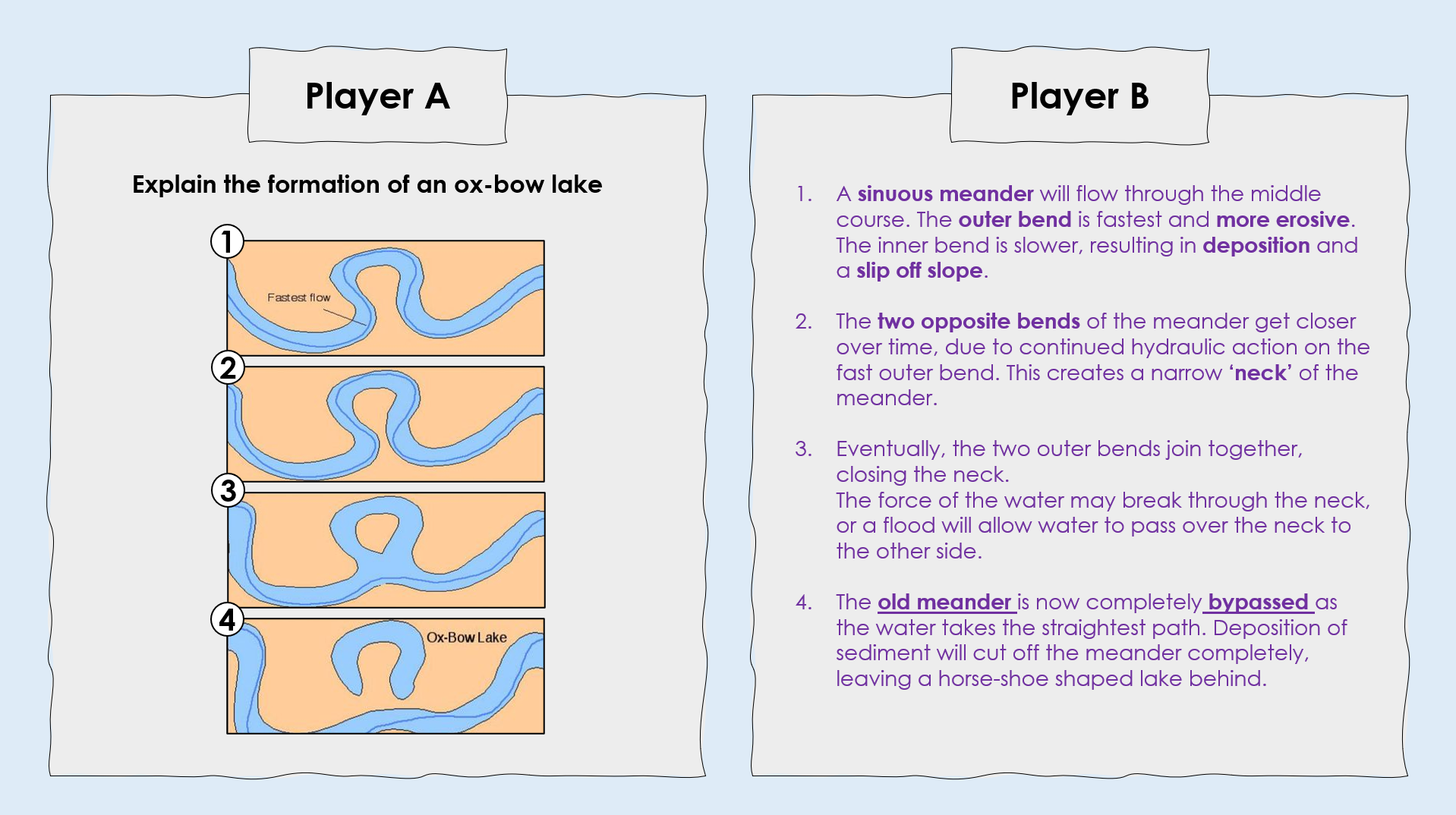
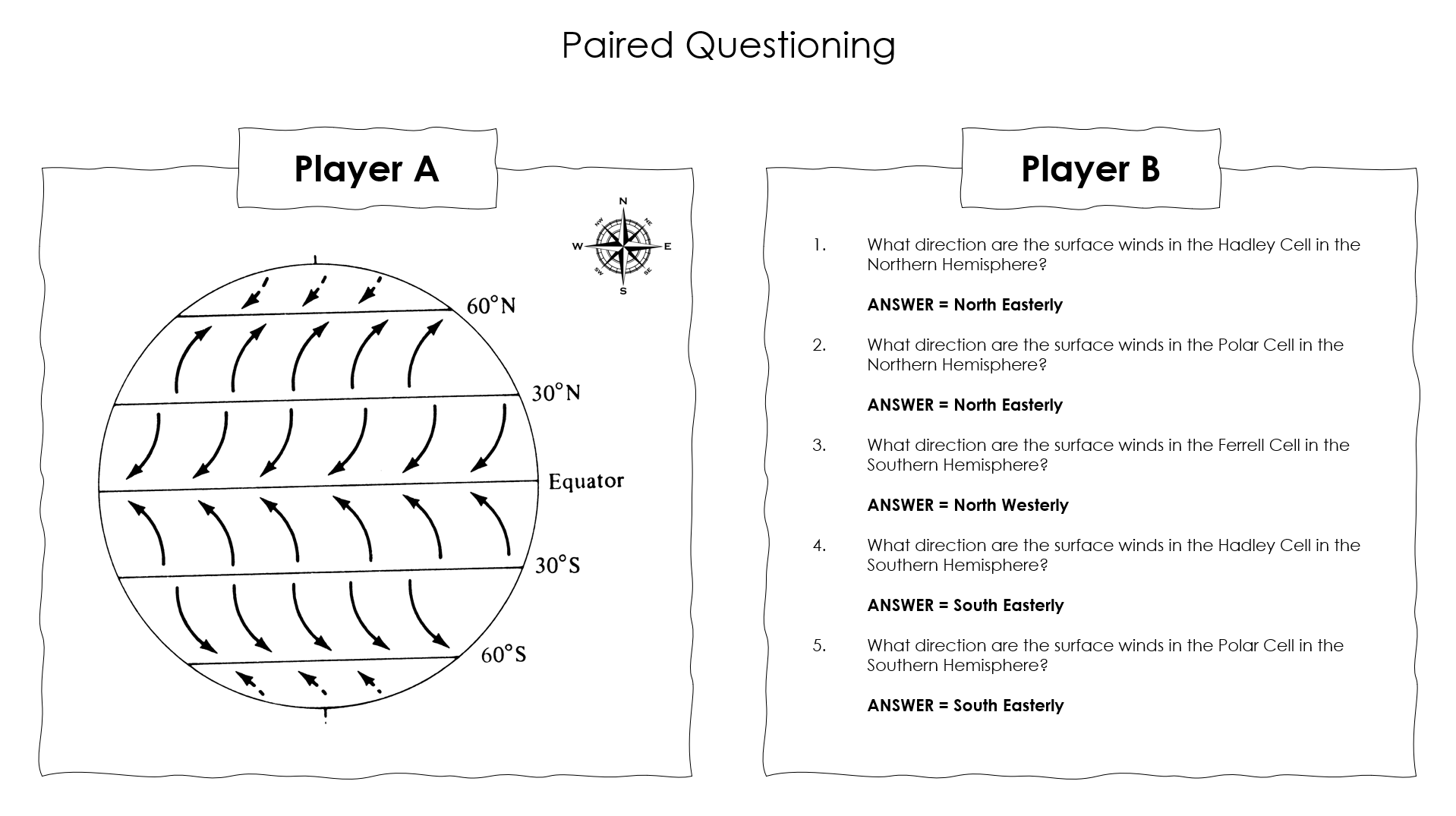
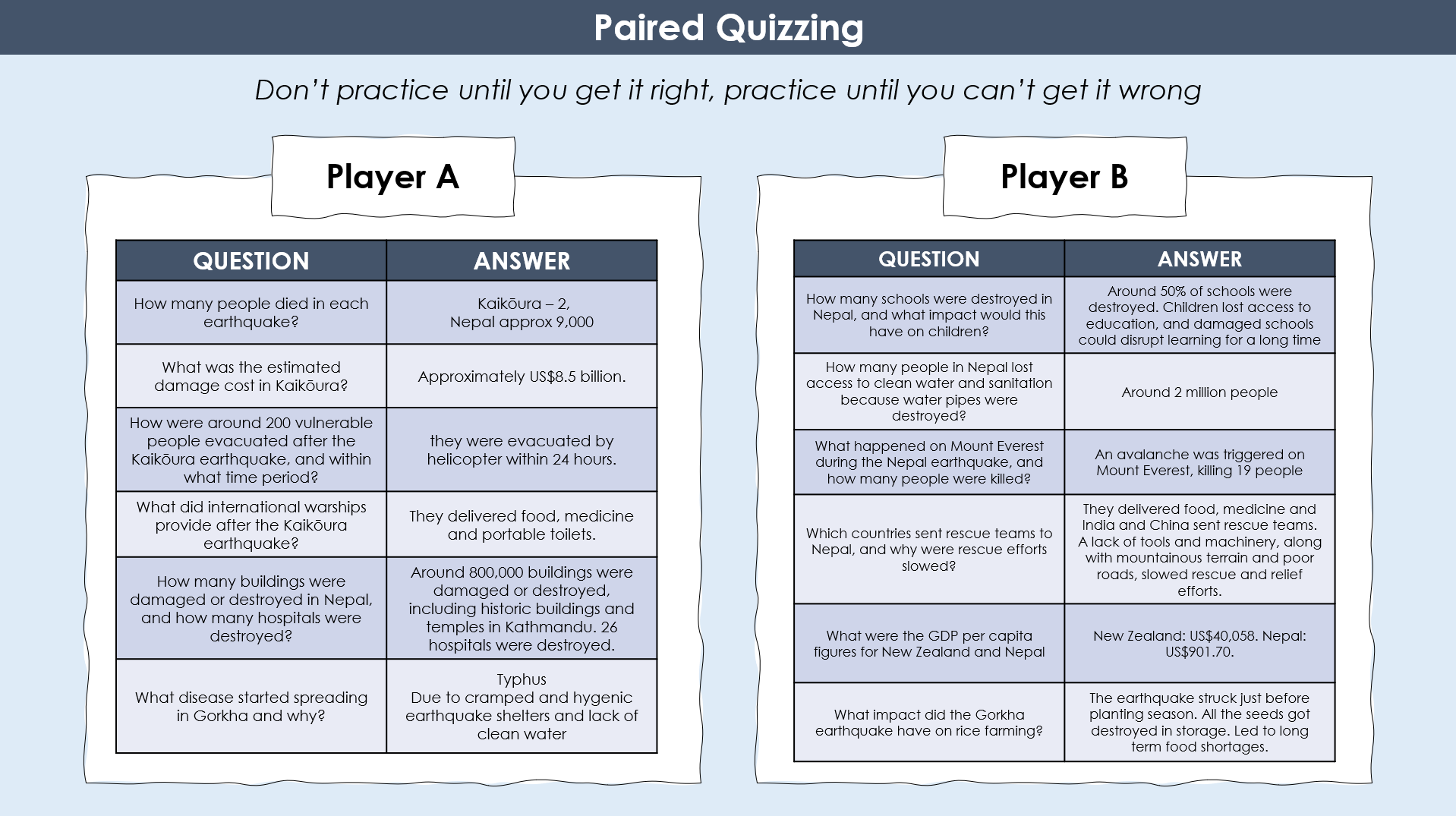
I have also found it useful to use this idea for case study recall (see above). Something that isn’t a sequenced explanation, but rather facts and figures that students have to remember. Give them some cards like these next time you teach your two contrasting earthquake case studies, and let them test each other out loud for a bit. See if it boosts their retention of the facts come next lesson?!
To revisit the start of this post in conclusion - most students are more likely to remember something that they have talked about.
Thank you to Tom Sherrington and his writing on Teaching & Learning for the inspiration behind the activity.